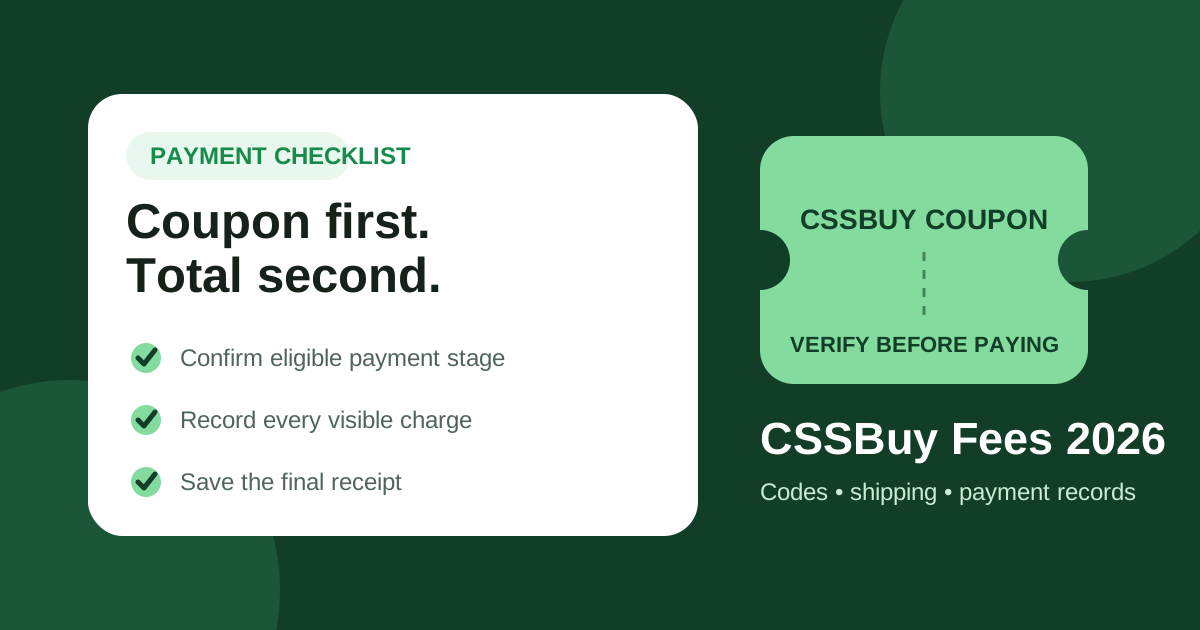
Search results for CSSBuy coupons often mix active promotions, referral claims, expired screenshots and codes copied from one payment stage into another. A buyer may see a large percentage in a headline and assume it reduces every cost, yet the code may apply only to an eligible international shipping payment, a selected account, a limited route or a defined campaign period. The only reliable result is the one shown in the buyer’s current account immediately before payment.
This matters because a CSSBuy transaction is not one price. Product value, Chinese domestic freight, optional warehouse work, payment effects, international shipping and destination charges happen at different times. A small coupon can be real while the overall haul still exceeds the original plan. The safest workflow therefore verifies the discount and the total cost separately.
Start With the Payment Stage, Not the Code
Before testing a coupon, name the payment it is supposed to reduce. Is it connected to a seller order, a top-up, warehouse service or international parcel? A phrase such as “CSSBuy shipping coupon” is more specific than “CSSBuy discount,” but it still does not prove which routes, destinations or account conditions qualify. Write the intended stage beside the code so you do not mistake a valid promotion for a universal price reduction.
Open the current CSSBuy screen for that payment and record the total before entering anything. Note the currency and whether the amount is an estimate, deposit or final charge. Enter the code exactly, read the response, and confirm that the payable total changes. A success-looking message without a lower total is not enough evidence. If the interface displays a discount line, save it with the full total rather than cropping the screenshot around the coupon alone.
Build a CSSBuy Fee Ledger
A fee ledger prevents a coupon from hiding a larger cost. Create one row for every stage and keep quoted, estimated and final amounts in separate columns. The first row is the live product price charged by the third-party seller. The next is Chinese domestic freight from the seller to the warehouse. Add requested services only when they are selected. Later rows cover the international parcel, any payment or currency difference visible in the transaction, and possible destination-side taxes or carrier charges.
Do not force every adjustment into a single category called “CSSBuy fees.” That label makes it hard to discover what changed. If a seller raises domestic freight, record it as seller-to-warehouse shipping. If packed dimensions increase the billing weight, record that difference in the parcel row. If the payment provider shows a different settled amount, preserve the account and payment records separately. Clear categories make support questions easier to investigate.
| Ledger row | Record before paying | Verify afterward |
|---|---|---|
| Product | Live item price, variant and quantity | Order receipt and seller adjustment |
| Domestic freight | Seller-to-warehouse charge | Final order record |
| Warehouse options | Only services intentionally selected | Service completion and charge |
| Payment | Currency, displayed total and funding method | Account credit and payment receipt |
| International parcel | Weight, volume, route and coupon | Packed measurement and final adjustment |
| Destination | Possible tax or carrier collection | Official local receipt if charged |
Test Coupon Eligibility in Five Steps
First, check whether the code has a visible validity period. A copied post may remain online long after the campaign ends. Second, identify account limits such as new-user eligibility or single use. Third, inspect any minimum payment requirement. Fourth, check whether the code is limited to a route, destination, service or payment stage. Fifth, test whether it can be combined with another discount. Never infer stacking from two codes existing at the same time.
If the code fails, save the exact error instead of trying random variations. “Expired,” “not eligible,” “minimum not reached” and “already used” are different outcomes. They tell you whether to stop, adjust the eligible payment, or ask a focused question. Do not change the parcel solely to chase a small threshold unless the revised route, weight and delivery conditions still make sense.
Separate Top-Up Value From Checkout Value
A top-up adds usable account balance, while a coupon changes an eligible charge. Those are different records. Before funding the account, estimate the payment that will actually be due and leave enough room for known adjustments without depositing solely because a promotional headline creates urgency. After the transaction, reconcile the amount charged by the payment method with the balance credited to the account.
If the bank or provider shows a charge but the balance does not update, do not repeat the payment immediately. Save the transaction reference, amount, currency, time and account status. A second top-up can create a duplicate problem while the first payment is still being reconciled. Coupon verification should never weaken payment discipline.
Check Product and Warehouse Costs Before Shipping
Discounted international shipping cannot repair a poor product decision. Confirm that the live seller listing still matches the spreadsheet entry, selected variant and expected price. Record domestic freight and review warehouse photos promptly. If an item is wrong, damaged or materially different, the return or exchange decision is usually more important than a later shipping coupon.
Optional warehouse services should solve a named problem. Extra photos should answer a specific approval question. Protective packaging should match fragility. Box removal should be weighed against product protection. Vacuum packing is useful mainly when compressible items create avoidable volume. Record the chosen service and reason so it remains clear whether the charge delivered value.
Calculate the Parcel Before Applying a Shipping Coupon
CSSBuy’s public cost calculator asks for destination, weight, volume and commodity attributes. That structure shows why a single coupon cannot determine the shipping decision. The parcel must first be eligible for a route, and chargeable weight may depend on the packed dimensions rather than product weight alone. Compare a realistic lower and higher case before treating any discount as savings.
Use warehouse measurements when available. Check the selected line’s current rules and the item attributes that may limit route choice. Compare tracking, expected transit information, compensation terms and packaging needs alongside price. Then apply the coupon to the eligible payment and record the difference. The cheapest displayed total is not automatically the safest or most suitable parcel plan.
Use a Before-and-After Payment Record
A clean receipt set should reconstruct the whole decision. Save the parcel number, chosen route, packed weight, dimensions, base charge, optional services, discount, final payable total and currency. If a later adjustment appears, add it as a new line rather than replacing the original figure. This creates a trail that explains why the first estimate and final result differ.
Use the same method for an order payment. Preserve the live seller price, domestic shipping, selected option, coupon response if relevant and final receipt. When an amount changes, ask which ledger row changed. A precise question such as “Why did domestic freight increase?” is easier to answer than “Why are the fees high?”
Common Coupon and Fee Mistakes
The first mistake is counting a discount before it is accepted. The second is comparing only the percentage while ignoring the eligible base. The third is confusing a shipping promotion with a seller product discount. The fourth is topping up from a headline rather than a verified payable total. The fifth is changing parcel composition only to cross a threshold, even when the added weight or volume costs more than the coupon saves.
Another common mistake is comparing two buyers’ totals without matching destination, route, packed size, item attributes and payment time. Their results may both be accurate while being unsuitable comparisons. Use your own ledger as the baseline and current account records as the source of truth.
The Final 60-Second Check
Before pressing pay, confirm the live payment stage, destination, currency and account. Read the coupon result. Check that the discount appears as a separate line and the total is lower. Review the ledger for missing domestic freight, optional services, packaging, chargeable weight or destination costs. Save the final screen and receipt. If any important amount is still unclear, pause and identify the exact row rather than paying to discover it later.
The safest CSSBuy coupon strategy is deliberately simple: never promise yourself a discount that the current checkout has not confirmed. The safest fee strategy is equally simple: give every charge a name, a stage and a receipt. Together, those habits turn “CSSBuy coupons” and “CSSBuy fees” from vague search terms into a payment record you can verify.
Frequently Asked Questions
Where should I verify a CSSBuy coupon code?
Use the current CSSBuy payment flow where the discount is supposed to apply and confirm the final total decreases.
Is a CSSBuy coupon the same as a product discount?
No. It may apply to shipping or another defined payment stage rather than the third-party seller price.
Why might a CSSBuy coupon code fail?
It may be expired, limited by account or route, below a minimum spend, already used or entered at the wrong payment stage.
Can I rely on a code shown in an old post?
No. Treat it as a lead and verify the code and terms in the current checkout.
What CSSBuy fees should I record?
Separate product price, domestic freight, chosen services, payment effects, international freight and destination-side charges.
Does the cheapest item create the cheapest parcel?
No. Weight, volume, packaging and route eligibility can outweigh a low product price.
Should I top up before checking the total?
Build the expected ledger first, then fund the verified payment need rather than a promotional headline.
What should I save after using a coupon?
Save the code, eligibility message, before-and-after total, currency, time and receipt.
Can several CSSBuy discounts be combined?
Only current terms and the payment interface can confirm stacking, so test the combination before paying.
What is the safest coupon rule?
Count a discount only after the payment screen accepts it and the final payable total visibly decreases.